Concept: The Making of Funnel Vision.
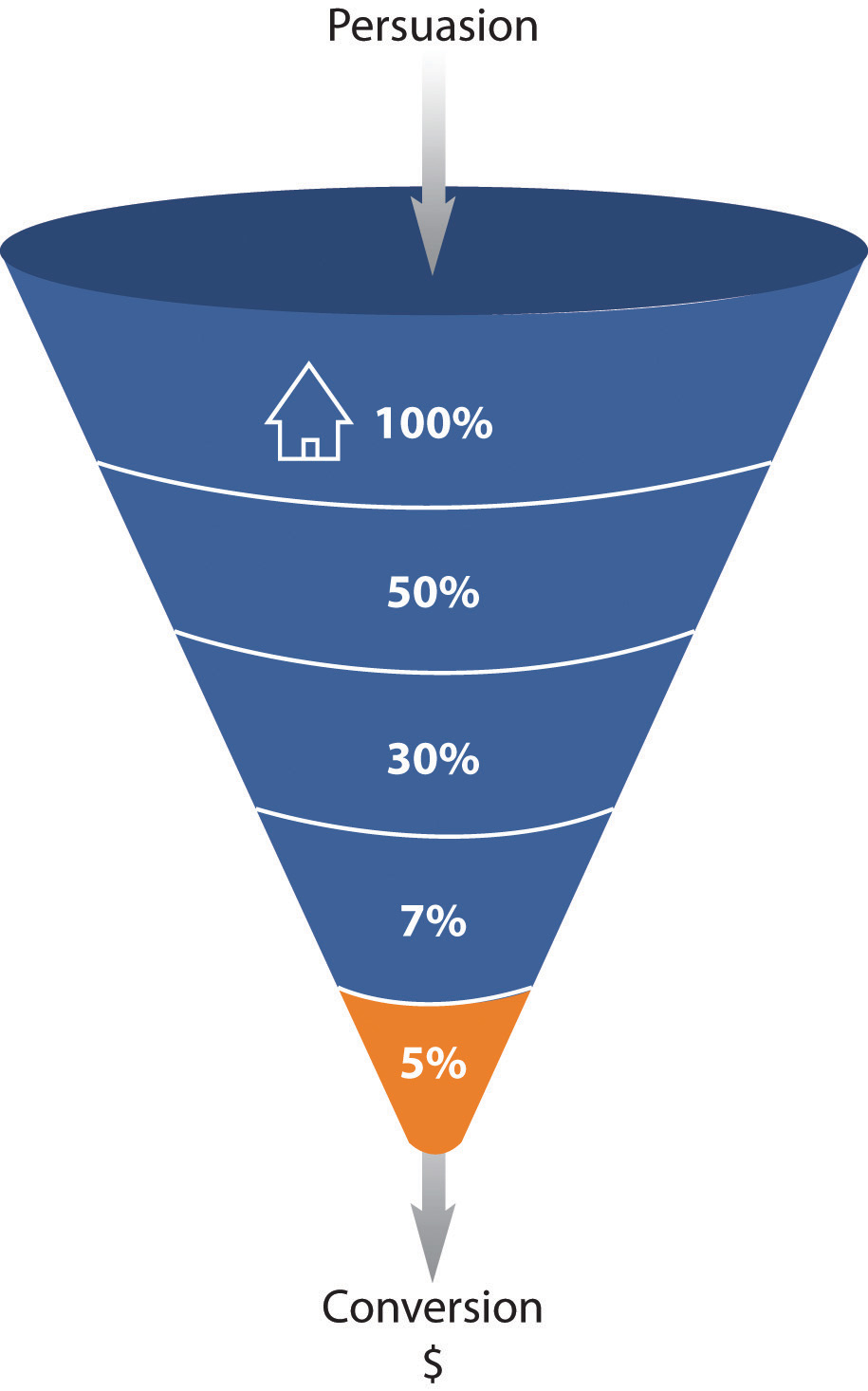
Week 2's readings brought us more detail about how exactly you can optimize your website and increase your click-through rate (aka increase the amount of people buying stuff from you!). With this optimization comes funnel vision. In reality, it's called funnel analysis, however funnel vision has a nice ring to it... In essence, funnel analysis breaks down the path that visitors should take to reach the final objective and analyzes events according to conversion rate to show you which steps you are losing the most potential customers on. This is very useful to website owners because if you can isolate where exactly in the click-through process you are losing a customer's interest, and why you are losing their interest, you can work to optimize your website and improve the number of customers continuing on to the next step. An example of how this all works:
Lets say you own a small business which specializes in hand-painted pictures. Your ultimate goal is to get customers to purchase your pictures with their credit card.
Event 1: Perform a search for custom artwork and find your website
Event 2: Check out the available pieces and their prices
Event 3: Select the piece you would like to purchase and go to check-out
Event 4: Enter your credit card information and shipping details and confirm purchase (conversion)
You expect fewer people at each event step; that's why it's called a funnel. If you are able to increase the number of customers flowing through each step, you will be able to increase your conversion rate and ultimately increase your sales. The question that arises from the use of this funnel is what to do with the information. If you have 2 steps, for example, where you are losing a significant portion of your potential customers, which step is the most important to fix first? Is it possible to get an extremely high (respectively) click-through rate if you 'fix' your funnel?

Illustration of Funnel Analysis and Conversion Rate (Source: eMarketing Text)
Concept: Websites Know Where You're Coming From (Like, Geographically.)
This week's readings also talked about visit characterization, which in essence are terms and concepts that help website advertisers figure out where their customers are coming from. This knowledge allows advertisers to see if more customers are coming from search engine sites like Google or being linked to the website from other websites carrying similar products, etc. Knowing this allows them to put their advertising resources where they will have maximum potential to reach customers. There are two key visit characterization groupings with several terms that are important including (Group 1) Entry Page, Landing Page, and Exit Page and (Group 2) Internal Referrer, External Referrer, Search Referrer, Visit Referrer, and Original Referrer.
Group 1:
Entry page. The first page of a visit.
Landing page. The page intended to identify the beginning of the user experience resulting from a defined marketing effort.
Exit page. The last page of a visit.
Visit duration. The length of time in a session.
Group 2:
Internal referrer. A URL that is part of the same Web site.
External referrer. A URL that is outside of the Web site.
Search referrer. The URL has been generated by a search function.
Visit referrer. The URL that originated a particular visit.
Original referrer. The URL that sent a new visitor to the Web site.
(Source: eMarketing Text)
How marketers decide to use this knowledge is up to them, however questions remain about what to do with the knowledge. If you find that most of the visitors to your website are coming from Google, do you spend more advertising money there because you already have a customer base coming from the source, or do you focus more of your resources on outlets where you do not have a lot of traffic coming from?
Skillset: A/B Split Testing to See Where You're Going Wrong
It becomes important as you're progressing through your ad campaigns to see where you start going wrong, and see which text group is more effective at increasing your conversion rate. While A/B Split Testing takes more time, I also believe it to be the most effective method for determining which advertisement phrases are more effective. A/B split testing measures one variable at a time to determine its effect on an outcome. Different versions are created for the variable you want to test and all other elements on the Web page, in the e-mail, or part of the PPC advertisement remain the same. The results are then interpreted to see if there is a statistically significant difference between the variables. The version producing the best results can then be employed. To give an example of this, say again you were trying to advertise your hand painted pictures. You create two (or more, it just takes more time with more) email subject headlines and keep the entire body of the email exactly the same. Sending out the first email with subject headline #1 will give you data on the first subject lines open rate, and then sending out the second email with subject headline #2 will give you data on the second subject line open rate. Once all the potential headlines have been sent out (over time) you can then compare the open rates for all of the various subject headlines to determine which was the most effective at getting people to open the email. This will allow you to hone in one what will encourage potential customers to open the emails you send more often, potentially increasing both your open rate as well as your conversion rate and your sales. A main question for A/B Split Testing though is how long you should give between testing variables A and B. The book does not mention a time frame for the tests, but I would imagine it needs to be on the shorter end to ensure timely delivery of an advertisement.
The Next Steps in eMarketing
We went into much greater detail this week about the complications of eMarketing, and how marketers figure out where their advertising is going astray. This is extremely important because marketers need to know how to fix mistakes and continue to improve upon campaigns. While it is rewarding to be able to know when and where you need to make changes in your campaigns, this also presents a lot of challenges, some of which I don't feel were adequately addressed in the text. I felt like the text focused on telling readers how to figure out if something was not functioning as you had imagined it would in your campaigns, however it did not guide you as to fixing the problem. For example, if I found that one email headline worked better than another with my A/B Split Testing, would I stop trying different headlines and only use ones like the best one of the two tested? Or should I keep trying new ones? What is considered a successful click-through rate or a successful email open rate? Overall, I did learn a lot on the process of fixing mistakes in campaigns this week, and I am looking forward to perhaps getting some of the details which I feel the book left out or learning even more techniques on the best way to capture a wide market.

I think Casey's blog raises some good questions about A/B Split Testing. It's hard to recognize what the best practices are for this kind of marketing work. For other outlets of marketing there are very obvious ways to manage and market the products and services. Though Google Adwords tends to give you a lot of information about what ways to market yourself, it's difficult to take yourself out of the algorithms and trust your instincts.
ReplyDeleteHi Casey interesting idea about "fixing your funnel!" also you asked some really critical questions - our text provides basic definitions and your through provoking questions definitely go beyond what the text covers!
ReplyDelete